Programme Highlights
- Global uniqueness: A unique master's programme hardly to be found anywhere else worldwide
- Fully taught in English: Ideal to step into a career in industry, services (quality assurance), research ans science even worldwide
- Interdisciplinary: Integrating applied physics, mathematics, computer science, engineering and materials science
- Integrated certification course: Qualify for highest testing competence (Level III NDT Inspector status) – including three separate examinations
- International research internship: 10-week Research Internship (16 CP) can be completed anywhere worldwide including research establishments, universities or industries
- Thesis abroad: Master's thesis research can be carried out at partner institutions worldwide
- Flexible study modes: Full-time (on-campus, 4 semesters) or part-time (Blended Learning / online with on-site components, 6 semesters)
- Small cohorts: 10–20 students per intake – guaranteed personal supervision and extensive knowledge share
- Renown cooperation partners: i.e. BAM, Fraunhofer, Airbus, Rohmann GmbH, SVTI, Testia and universities in France, Italy, Poland and Germany
- Renown lecturers from industry and academia: Teaching delivered by experts from leading research institutions and industrial compani
Why study NDT at the University of Applied Sciences Kaiserslautern?
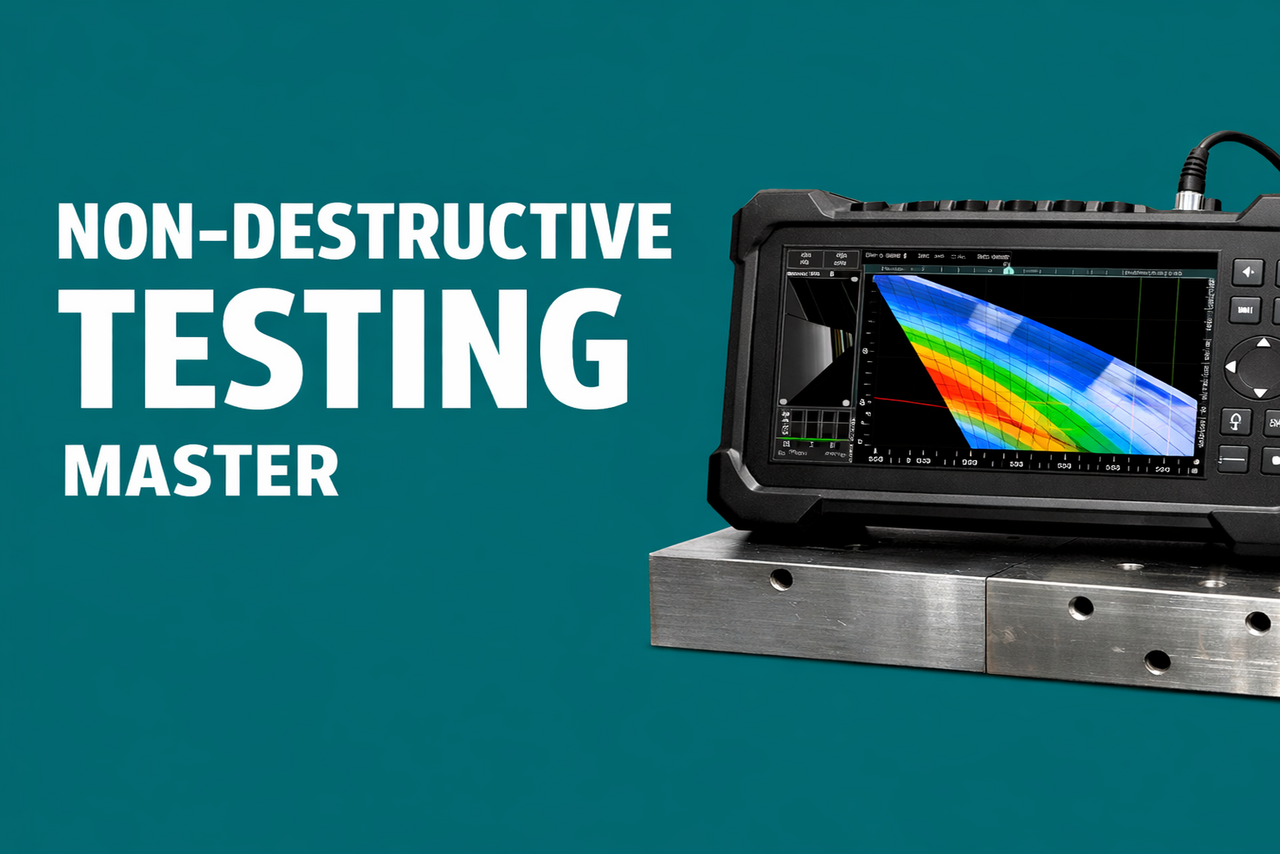
Non-destructive testing (NDT) is a key technology in modern industries – ranging from aerospace via transport (rail, road, marine, pipeline), energy generation, engineering (civil, electrical, mechanical, process) up to food processing. NDT is a must whenever quality plays a role. The NDT master's programme at the University of Applied Sciences Kaiserslautern is one of the very few such programmes worldwide that addresses this interdisciplinarity at an academic master's level. Through the integrated certification course, the international research internship and close ties with industrial partners, our graduates are ready to work as fully-fledged NDT professionals from day one. Kaiserslautern as a science and technology hub provides an ideal environment for study, research and professional networking.
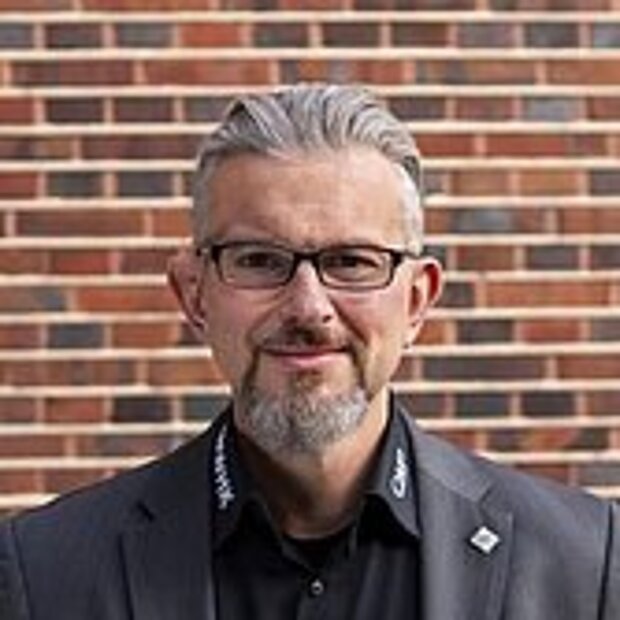
"Non-destructive testing is more than a technique – it is the language in which materials report on their own condition. With this master's programme, we train experts who speak this language fluently and ensure the safety of critical structures in a changing world. I invite you to become part of a small but globally-minded community that sets the standard for the NDT of tomorrow."
Prof. Dr.-Ing. habil. Peter Starke
Background and Motivation
Non-Destructive Testing (NDT) is one of the most important cross-sectional technologies in modern industry. It enables the evaluation of materials, components and structures being non-invasive, making it indispensable for quality assurance and operational safety in safety-critical sectors such as aerospace, energy supply, automotive and nuclear engineering, and micro- and nanoelectronics to just name a few.
Despite its enormous economic and societal relevance, NDT as an independent academic discipline at a master's level is barely established worldwide. Knowledge and methods have so far been conveyed primarily through industrial practice or dispersed training formats. The NDT M.Sc. programme at the University of Applied Sciences Kaiserslautern addresses this gap directly: it is one of the fewer if not even the unique of comparable master's programmes worldwide, closing a strategically important qualification gap in the global engineering talent market.
The programme was developed with the participation of leading research institutions, industrial companies and international university partners, and is aimed at graduates of engineering and natural science programmes who wish to deepen their expertise in a highly specialised, internationally sought-after field at master's level.
Guiding Concept
The M.Sc. NDT programme combines scientific depth with immediate practical relevance. The guiding concept is: to develop, apply and critically evaluate future inspection and quality assurance methodology based on scientifically sound principles – in interdisciplinary teams, in an international environment, and with the clear objective of permanently improving the safety and reliability of technical structures.
The programme integrates fundamental knowledge in materials science, measurement technology and mechanics with all major NDT method families (i.e. acoustic, electromagnetic, radiological, optical, thermal and microscopy), as well as competencies in scientific work, international collaboration and professional certification.
Distinct Features of the Programme
Interdisciplinarity
NDT is by definition an interdisciplinary field. The curriculum deliberately connects contents from applied physics, materials science, engineering, applied mathematics and computer science / signal processing. This integration allows students to approach NDT problems holistically and solve them beyond disciplinary boundaries.
International orientation
Fully English-language teaching, an international research internship, the possibility of a thesis to be performed anywhere worldwide, and active partnerships universities and industries on a national and international basis make NDT a genuinely international programme. The student cohort reflects this international character.
Flexible study modes
The programme is designed for both full-time study (4 semesters, on-campus in Kaiserslautern) or part-time study (6 semesters, Blended Learning with online phases and on-site components). This enables working professionals to pursue structured further qualification without a full career break.
Profile as a Continuing-Education Degree Programme
Non-Destructive Testing is designed as a continuing-education Master's programme – tailored specifically to people who already hold a first professional degree and have relevant work experience. We see our students not as beginners but as emerging specialists who want to deepen their existing knowledge on a scientific level and add the internationally sought-after key competence of non-destructive testing. Our support concept, study organisation and examination schedule are designed precisely around this.
Who this programme is for
The programme is aimed at graduates of engineering and natural-science programmes as well as qualified professionals who wish to earn a recognised scientific degree at the highest academic level alongside or after their career. Whether you work in quality assurance, research and development, inspection, or a technical leadership role, you will find small cohorts (10–20 students), fully English-taught courses, and a programme that can be studied full-time or part-time to fit an existing career.
Target-group-specific advising and support concept
Because our students combine work, family and study, we rely on personal, reliable support – from the first enquiry to the Master's thesis:
- Personal pre-application advising: The programme management advises you individually on admission requirements, recognition of prior achievements, the choice between full-time and part-time study, and the fit of your previous studies.
- Dedicated contacts throughout your studies: You are supported continuously by the programme management and teaching staff rather than being handed from semester to semester.
- Small groups, direct contact: The small cohort size allows intensive, dialogue-oriented exchange with lecturers, including external experts from research and industry.
- Supervision during the practical phase: For the research internship and the Master's thesis, a supervising examiner accompanies you throughout, with clear agreements on objective, scope and schedule.
- Individual planning in the part-time model: The part-time programme (6 semesters, blended learning) is coordinated individually with the examination board where needed, to adapt it to your professional situation.
Your contacts:
- Programme Director: Prof. Priv.-Doz. Dr.-Ing. habil. Peter Starke — peter.starke(at)hs-kl.de, +49 631 3724-2389
- Deputy Programme Director: VertProf. Dr.-Ing. Fabian Weber — fabian.weber(at)hs-kl.de, +49 631 3724-2259
- Organisation & examination matters: Dean's Office of the Department of Applied Engineering Sciences/Examination Office
Schedule of courses and frequency of examinations
To make your studies reliably plannable, the timeline is clearly structured and recurring:
- Start of studies: winter semester only (one intake per year). Application phase from around April, annual application deadline on the set date, admission in June/July, start of studies on 1 September, lectures beginning in early October.
- Frequency of examinations: each module concludes with its own examination; the main examination period is in February/March as well as August. Examinations are offered on an annual cycle in line with the respective module offering, so that examination dates are predictably linked to the course sequence. A repetition is possible within the next exam period (each half year). The integrated certificate course (BC-Course) comprises three separate examinations; the research internship and Master's thesis are assessed through a report, a presentation and a colloquium. All examinations are held in English.
Binding deadlines, dates and examination rules are set out in the applicable Fachprüfungsordnung (subject-specific examination regulations) and the official semester dates of the University of Applied Sciences Kaiserslautern.
Career Prospects
Graduates of the M.Sc. Non-Destructive Testing programme are qualified for a wide range of highly skilled positions in safety-critical industries as well as services and scientific institutions:
- Inspection engineers in high-technology companies and engineering consultancies in aerospace, automotive, rail and marine engineering, energy generation, engineering technology (civil, electrical, mechanical, process), mining and earth science, and even food processing.
- Quality assurance and structural integrity specialists in manufacturing companies, infrastructure operating organisations and services
- Research and development at federal agencies (e.g. BAM, BASt, MPA, PTB), major research organizations (i.e. DLR, Fraunhofer, Helmholz, Leibniz) universities and R&D and quality assurance departments of various industries
- Equipment manufacturers and engineering consultancies in the NDT industry (hard- and software development, application consultancy)
- Certification bodies and regulatory authorities (Level III activities: development, qualification and auditing of inspection systems)
- Consulting and project management in safety-critical infrastructure projects (energy supply, construction, offshore)
Preparing graduates for immediate deployment in one of engineering's most sought-after specialist disciplines.
Programme Structure at a Glance
The NDT Master's programme is structured, in its full-time format, across four semesters of 30 ECTS credits each. Each phase pursues a clear didactic function and builds on the preceding one. One ECTS credit corresponds to a workload of 30 hours (contact time and self-study combined).
- Phase 1 / Semester 1 – Basic Modules (BM): Interdisciplinary foundations of NDT (30 CP)
- Phase 2 / Semester 2 – Special Modules (SM): NDT testing method families in depth (30 CP)
- Phase 3 / Semester 3 – Practical Modules (PM): Certification + Research Internship (30 CP)
- Phase 4 / Semester 4 – Excellence Module (EM): Master Thesis + Colloquium (30 CP)
Total: 120 CP
Semester 1 – Basic Modules (BM)
Interdisciplinary Foundations for Non-Destructive Testing
The first semester establishes the scientific and methodological foundations for all subsequent stages of the programme. The five Basic Modules cover the core disciplines on which non-destructive testing is built.
- BM 1.1 Materials Science (6 CP): Metallic, polymeric and composite materials; material properties and defect types
- BM 1.2 Measurement Techniques (6 CP): Theoretical foundations of measurement technology; structure of a measurement chain
- BM 1.3 Mechanics (6 CP): Sound and vibration; fatigue and fracture mechanics
- BM 1.4 Numerical Methods & Signal Processing (6 CP): Numerical methods; digital signal processing in NDT
- BM 1.5 Introduction into NDT & Quality Management (6 CP): Overview of all NDT methods; quality assurance and standards (EN ISO 9712, ISO 9001, etc.)
Total: 30 CP
Semester 2 – Special Modules (SM)
In-Depth Treatment of the NDT Testing Method Families
The second semester addresses the most important NDT testing method families in a systematic and scientifically rigorous manner. Each module is dedicated to a distinct method family, covering its theoretical foundations and practical testing applications.
- SM 2.1 Acoustic Methods (6 CP): Ultrasonic testing techniques; specific acoustic methods (e.g. TOFD, Phased Array)
- SM 2.2 Electromagnetic Methods (6 CP): Magnetic and magneto-inductive testing methods; eddy current testing
- SM 2.3 Radiological Methods (6 CP): X-ray and computed tomography; diffraction and spectroscopy methods
- SM 2.4 Optical Methods (6 CP): Visual testing, shearography, speckle interferometry, digital image correlation
- SM 2.5 Thermal & Microscopical Methods (6 CP): Infrared thermography; light and electron microscopy in materials testing
Total: 30 CP
Up to two modules of the second semester may be replaced by Specialisation Modules from closely related disciplines. This is subject to application to the Examination Board and enables individual focus areas to be set in accordance with the academic interests or professional background of the student.
Semester 3 – Practical Modules (PM)
Certification and International Research Internship
The third semester combines the acquisition of recognised industrial certifications with independent scientific work in an international research environment.
- PM 3.1 BC-Course & Technological Visit (13 CP): Official DGZfP certification course (Basic Exam, Studies Exam, Final Exam); NDT Technology Visit
- PM 3.2 Research Internship & Scientific Writing (17 CP): 10-week research internship worldwide; Scientific Writing
Total: 30 CP
You can find the relevant guides and guidelines for the BC-Course and the Research Internship here
Semester 4 – Excellence Module (EM)
Master Thesis and Scientific Colloquium
The fourth semester is dedicated entirely to the independent scientific thesis. Students demonstrate their ability to conduct autonomous research at an international level.
- EM 4.1 Master Thesis + Colloquium (30 CP): Master Thesis (6 months, 20 CP) + Final Colloquium (30-minute presentation, 10 CP)
Total: 30 CP
Specialisation Modules
Upon application to the Examination Board, up to two modules of the second semester may be replaced by Specialisation Modules from related academic fields. This option allows students to set individual priorities and tailor the programme to specific academic interests or prior professional experience. Possible areas of specialisation include, among others:
- Artificial intelligence and machine learning in NDT
- Structural mechanics and finite element methods
- Sensor technology and embedded systems
- Data analytics and digital twins
Research Internship
The Research Internship is a central element of the third semester and comprises a minimum of 10 consecutive weeks (16 CP). It may be carried out worldwide at recognised research institutions, industrial companies, or partner universities. Possible host organisations include:
- Cooperation partners of the programme (e.g. BAM, Fraunhofer, Airbus, Rohmann, SVTI, Testia, among others)
- Partner universities in Germany and abroad
- Further recognised research institutions or industrial companies worldwide (subject to approval by the Examination Board)
The accompanying Scientific Writing module (1 CP) prepares students for writing academic texts and documenting their research work.
ou can find the relevant guides and guidelines for the Research Internship here
Master Thesis
The Master Thesis (20 CP, 6 months) is completed in the fourth semester and may be carried out worldwide – at Hochschule Kaiserslautern, at a cooperation partner, or at a recognised research institution. Topic areas include:
- Development of theory and experiment for existing and emerging NDT methods, and their application in industry and research
- Numerical methods in NDT (FE analysis, signal processing, imaging, NDE 4.0, AI)
- Application projects at cooperating companies or research institutions
- Standardisation, qualification, and certification of NDT technology
Part-Time Programme (Blended Learning, 6 Semesters)
The programme can be completed entirely on a part-time basis. The part-time model distributes the modules of the full-time programme across six semesters and is designed as a blended learning format, combining on-site sessions with online teaching formats. The schematic course of study in the part-time model:
- PT Semester 1: BM 1.1, BM 1.2, BM 1.3
- PT Semester 2: BM 1.4, BM 1.5 + SM 2.1
- PT Semester 3: SM 2.2, SM 2.3, SM 2.4
- PT Semester 4: SM 2.5 + BC-Course (PM 3.1)
- PT Semester 5: Research Internship & Scientific Writing (PM 3.2)
- PT Semester 6: Master Thesis + Colloquium (EM 4.1)
The exact distribution is agreed individually with the Examination Board.
Examination System
- Each module is concluded with an individual examination; the form of assessment (written examination, oral examination, term paper, report, etc.) is specified in the respective module handbook
- The certification course module (PM 3.1) comprises, in the case of the DGZfP BC-Course, three separate examinations (Basic Exam, Studies Exam, Final Exam)
- The Research Internship (PM 3.2) is assessed by means of an internship report and a meeting with the supervising professor
- The Master Thesis is assessed by two examiners; the Colloquium takes place before an examination committee
- All examinations are taken in the English language
Admission Requirements
To be admitted to the M.Sc. Non-Destructive Testing programme, the following requirements must be met:
1. Higher Education Degree
- A relevant qualifying higher education degree with a minimum of 180 ECTS credits in one of the following fields or a related area:
- Engineering science (mechanical, electrical, aerospace, civil, process, geotechnical, systems incl. mechatronics etc.)
- Natural sciences (physics, chemistry, materials, etc.)
- Computer science and informatics
- Comparable technical or scientific disciplines (i.e. applied mathematics)
2. Professional Experience
- At least 1 year of relevant professional experience post first higher education degree graduation in a field of activity relevant to NDT (e.g. quality assurance, inspection technology, research and development, manufacturing, design and analytics)
3. Language Proficiency
- English language proficiency at a minimum level of B2 on the Common European Framework of Reference (CEFR) scale, evidenced by one of the following certificates (issued within the last 24 months):
- TOEFL iBT: minimum 87 points
- IELTS: minimum 6.0
- TOEIC Listening & Reading: minimum 785 points
- Cambridge B2 First (FCE) or higher
- Equivalent recognised certificates
- Native speakers of English are exempted from the certificate requirement.
- German language skills at a minimum level of A2 on the CEFR scale (required for all applicants regardless of native language, as the campus is located in Germany)
4. Subject-Specific Competence Evidence
The following content competencies must be evidenced through academic records (module certificates, transcripts) or equivalent documentation (minimum: 15 ECTS in mathematical/scientific fundamentals):
- Mathematical and scientific fundamentals (mathematics, statistics, physics; minimum 15 ECTS)
- Physics (at least one in-depth module related to waves, optics or electromagnetism is of advantage)
- Computer science / programming (basic skills, minimum one module; e.g. MATLAB, Python, C/C++)
- Engineering fundamentals (e.g. mechanics, design, measurement technology)
5. Aptitude Assessment (Exception)
Applicants who do not hold a higher education degree but possess a university entrance qualification (Hochschulzugangsberechtigung, HZB) and at least 3 years of relevant professional experience may undergo an aptitude assessment. The assessment comprises a specialist interview with the Examination Board and, where applicable, written tasks. Admission is at the discretion of the Examination Board.
Recognition and Crediting of Prior Achievements
Competences you have already acquired should not have to be earned twice. The Master's programme Non-Destructive Testing therefore offers several ways to recognise achievements completed at other higher education institutions as well as qualifications acquired outside higher education. The basis for this is the General Master's Examination Regulations (AMPO) and the subject-specific examination regulations (FPO) of the programme.
Recognition of study and examination achievements
Study and examination achievements completed at other higher education institutions are recognised, provided there is no substantial difference in the competences acquired compared with the achievements they are to replace in this programme. The relevant rules are set out in the AMPO.
Crediting of competences acquired outside higher education
As a continuing-education programme, Non-Destructive Testing explicitly takes into account qualifications acquired professionally and outside higher education. The examination board decides on possible crediting on a case-by-case basis, based on the evidence submitted.
Specialisation modules (replacement of compulsory modules)
During the course of study, up to two Special Modules may, upon application, be replaced by the recognition or crediting of previously completed, specialised achievements in the field of non-destructive testing. On the proposal of the programme management, the examination board decides on the recognition, on the designation of the specialisation module, and on which subject-related compulsory module is replaced. You may include a proposal on which module should be replaced with your application.
Research internship and periods abroad
The examination board decides on the recognition of practical projects at German or foreign higher education institutions as well as internships in companies or institutions within the framework of the Research Internship. If you plan a study or practical period abroad, please hold a discussion with the examination board on recognition eligibility before you leave and conclude a Learning Agreement; after your return, submit the application for recognition to the Examination Office.
How to proceed
Applications for recognition or crediting should be addressed to the examination board of the Department of Applied Engineering Sciences. We recommend seeking advice as early as possible – ideally before the start of your studies or before a planned period abroad. For any questions, the Programme Director (Prof. Priv.-Doz. Dr.-Ing. habil. Peter Starke) and the Deputy Programme Director (VertProf. Dr.-Ing. Fabian Weber) are happy to assist.
The currently valid subject-specific examination regulations (Fachprüfungsordnung) and the General Master's Examination Regulations (AMPO) of Hochschule Kaiserslautern apply. Decisions on recognition and crediting are made by the examination board.
Application Process
- Online application via the University of Applied Sciences Kaiserslautern application portal
- International applicants (without a German educational qualification) apply via uni-assist e.V. – preliminary document review
- Documents to be submitted:
- Completed online application form
- Copy of a valid photo ID
- Certified copies of all higher education degrees and transcripts (with translation into German or English if required)
- Current CV/résumé (tabular format, in English)
- Proof of professional experience (employment reference, certificate of employment, etc.)
- English language certificate (B2 or higher, issued within the last 24 months)
- German language certificate (A2 or higher), unless German is your native language
- Letter of motivation (in English, max. 1 page): explaining motivation for application, professional experience and goals
- Where applicable, evidence of subject-specific competencies (module overviews, certificates, etc.)
Application Deadline
|
|
Application deadline | 31. May (annually, for the following winter semester) |
Admission decisions | June / July |
Enrolment deadline | By end of August |
Programme start | 1 September (official start of semester) |
Lectures begin | Early October (approx. calendar week 40) |
Applications are accepted for the winter semester only. A summer semester entry is not available.
Admission Procedure and Aptitude Assessment
After receipt of the complete application documents, the Examination Board reviews the formal and subject-specific suitability of applicants. The following steps may be taken:
- Formal review: Completeness of documents, fulfilment of minimum requirements
- Subject-specific aptitude review: Assessment of degree, professional experience and subject-specific competencies
- Aptitude interview (if required): In cases of uncertainty, a personal or video-based interview with the Examination Board may take place
- Admission decision: Written notification in June/July
The programme has a limited number of places available. Admission is based on suitability; ranking of applicants is possible if places are oversubscribed.
Tuition Fees
The programme is designed as an advanced training master's programme and is therefore subject to tuition fees:
|
|
Tuition fees | approx. €4,200 per semester plus standart semester contribution |
Total cost | approx. €18,000 (full-time, 4 semesters) / approx. €18,600 (part-time, 6 semesters) |
Payment due | At the beginning of each semester |
Payment arrangements | Payment per semester; instalment payments may be possible by arrangement |
Note: Tuition fees are charged in addition to the standard semester fees at University of Applied Sciences Kaiserslautern. Current standard semester fees are … €/semester.
Information on scholarships and other funding opportunities is available from the Programme Director or the International Office.
Application and Contact
Further information and the application link will be published on the official programme page of the University of Applied Sciences Kaiserslautern in good time before the application portal opens.
Application portal:www.hs-kl.de (section: Application / Master's Studies)
International application via uni-assist:www.uni-assist.de
Questions about the application and programme:
Prof. Peter Starke
Programme Director M.Sc. Non-Destructive Testing
Chair of the Examination Board
E-mail: peter.starke(at)hs-kl(dot)de
Phone: +49 (0) 631 3724 2389
A good start to your studies begins long before the first lecture. We want to give our international students timely and transparent information about what to expect in the programme and how to arrive and settle in well. Together with the International Office (IO) of the University of Applied Sciences Kaiserslautern, the programme is developing a comprehensive information and support concept and draws on the IO's well-established services.
You will receive support in particular regarding:
- Visa and entry procedures: information and guidance on visas, entry, and the official steps required after arrival.
- Accommodation: orientation on student housing (Studierendenwerk Kaiserslautern) as well as the private rental market, including practical advice on searching for a room in good time.
- Orientation and induction programmes: welcome events, city tours, get-togethers, and intercultural preparation specifically for international students.
- Everyday life in Kaiserslautern and the region: information on daily life – from registering with the residents' registration office and health insurance to mobility and leisure.
- Administrative procedures: support with enrolment, registrations, and formalities.
- Language: proactive support in using English as the academic "lingua franca", as well as language-coach services to build German skills where needed.
Where to find this information: All services, contact persons, and current advising hours of the International Office are gathered on the IO website. These include a "Welcome Guide" with an arrival checklist, a leaflet on finding accommodation in Kaiserslautern, and a comprehensive FAQ section for international students.
➜ International Office of University of Apllied Sciences Kaiserslautern:www.hs-kl.de/en/international
➜ Contact & personal advising:International Office – Contact · e-mail: io(at)hs-kl(dot)de
For any programme-specific questions, the Programme Director (Prof. Priv.-Doz. Dr.-Ing. habil. Peter Starke) and the Deputy Programme Director (VertProf. Dr.-Ing. Fabian Weber) are also happy to assist.
Key Dates
Application and Admission Deadlines
Date / Deadline | Period |
Application portal opens | approx. April (annually) |
Application deadline | XXX (annually) |
Application processing period | June |
Admission / rejection notifications | June / July |
Response / acceptance of place | By end of July |
Enrolment deadline | By end of August |
Semester Dates (Winter Semester, Full-Time Study)
Event | Date / Period |
Official start of semester | 1 September |
Lectures begin | Early October (approx. calendar week 40) |
Module registration / deregistration | Calendar weeks 40 and 41 (first two weeks of lectures) |
Lectures end | End of January (approx. calendar week 3/4 of the following year) |
Examination period | February / March |
Lecture-free period (semester break) | March – September (except Research Internship in Semester 3) |
Contact for questions about dates and deadlines:
Prof. Peter Starke | peter.starke(at)hs-kl(dot)de | +49 (0) 631 3724 2389
University of Applied Sciences Kaiserslautern | Department of Applied Engineering Sciences (AING)
Questions concerning your studies?
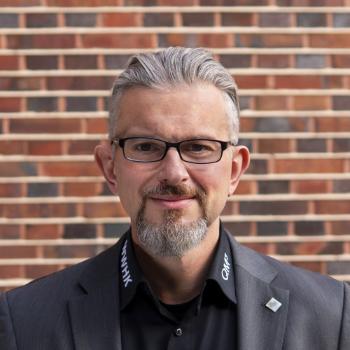
Vizepräsident für Forschung und Transfer, Studiengangsleitung "Maschinenbau, Bachelor", Fachbereichsrat AING

Assistent FB AING, Stellvertretende Fachgebietsleitung

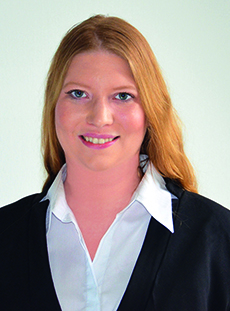
Dekanat FB AING, Dekanatsassistentin, ESF+ Projekt BMWi - Berufsbegleitender Masterstudiengang Wirtschaftsingenieurwesen FB AING, Prüfungsausschuss AING Bachelor, Prüfungsausschuss AING Master